


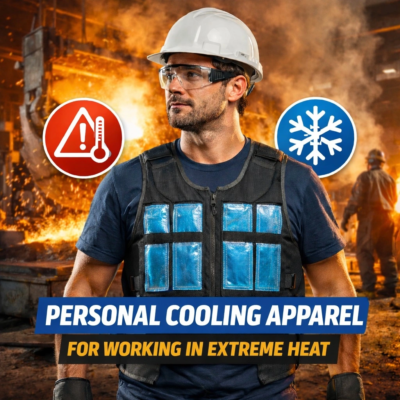
 Cooling Clothing for Working in Extreme Heat
In today’s industrial environments, heat stress is not just a matter of comfort; it is a critical challenge for occupational health and safety (OHS) and operational efficiency, especially when temperatures rise in foundries, logistics warehouses, or production plants.
In recent years, heat stress in the workplace has become a growing concern for health and safety managers, particularly in industrial sectors where temperatures can easily exceed recommended limits.
This is where cooling clothing emerges as an effective technical solution.
Unlike systems that attempt to cool entire buildings, this technology focuses directly on the worker, helping to reduce thermal load throughout the working day.
What is cooling clothing and how does it work
Cooling clothing is designed to help maintain body temperature within more comfortable ranges when workers are exposed to high temperatures.
Within this sector, INUTEQ-PAC® technology stands out, using Phase Change Material (PCM).
This material has the ability to absorb large amounts of heat as it transitions from a solid to a liquid state.
During this process, PCM maintains a constant temperature, providing stable and long-lasting cooling.
The packs are available in different temperature levels, allowing the system to be adapted to various working environments:
-
6.5 °C
-
15 °C
-
21 °C
-
24 °C
-
29 °C
In addition, the materials used are 100% bio-based, biodegradable, and certified under REACH and USDA, ensuring safe and sustainable use.
How the cooling process works
The system is based on the physical principle of latent heat.
Activation
The PCM pack is solidified by placing it in ice water, a refrigerator, or a freezer until fully solid.
Heat absorption
Once inserted into the garment, the material begins to absorb body heat.
Phase change
As the PCM changes from solid to liquid, it maintains a constant temperature, providing cooling for several hours.
Recharging
Once the material has fully melted, it can be cooled again for reuse.
Heat stress at work: a growing risk
Heat stroke is one of the most serious risks associated with high temperatures in the workplace.
When the body cannot properly dissipate heat, body temperature can rise rapidly and lead to serious health issues.
Common symptoms include:
-
dizziness
-
severe fatigue
-
headache
-
dehydration
-
loss of concentration
For this reason, more and more companies are adopting measures to reduce workplace heat stress, such as:
-
industrial ventilation
-
evaporative cooling
-
scheduled breaks
-
proper hydration
-
cooling clothing for workers
Benefits of cooling clothing for workers
The use of cooling clothing in industrial environments offers several advantages.
Reduced heat stress
By absorbing heat directly from the body, these systems help reduce the thermal load on workers.
Improved comfort during the workday
The constant temperature provided by PCM delivers a stable cooling effect.
Increased efficiency in hard-to-cool environments
In many industrial facilities, cooling large volumes of air is difficult. Cooling clothing works directly on the worker.
Types of industrial cooling clothing
Not all work environments are the same, so different configurations are available.
Cooling vests
These are the most common solution. They include pockets for inserting cooling packs.
An example is the Bodycool Pro vest, designed to use 8-cell packs.
High-coverage cooling vests
Models such as Bodycool Pro Neoprene use 16-cell packs, increasing the cooling surface on the body.
Active ventilation systems
Some garments include fans to enhance sweat evaporation. However, in extremely hot environments, PCM-based systems provide more stable cooling, as they do not depend on evaporation.
Sectors where cooling clothing is used
Cooling workwear is used in many industries:
-
metal industry and foundries
-
industrial production plants
-
logistics and warehouses
-
construction
-
agriculture
-
industrial kitchens
-
emergency services
Cooling the space vs cooling the worker
There are two main approaches to reducing heat in the workplace.
Cooling the space
This involves cooling large volumes of air using fixed or portable air conditioning systems.
In large or open facilities, this can be expensive and inefficient.
Cooling the worker
Cooling clothing creates a personal microclimate, helping to reduce heat stress directly on the body.
Comparison of solutions to reduce heat in the workplace
| Solution | What it cools | Advantages | Limitations |
|---|---|---|---|
| Industrial air conditioning | Air in the space | Precise temperature control | High cost in large facilities |
| Evaporative coolers | Ambient air | Low energy consumption | Requires ventilation |
| Industrial fans | Air movement | Cost-effective | Does not reduce temperature |
| Cooling clothing | The worker | Direct cooling | Individual coverage |
How to choose the right cooling clothing
When selecting this type of solution, consider:
Ambient temperature
Hotter environments may require lower temperature packs.
Work duration
The thermal capacity of the PCM determines how long the cooling effect lasts.
Garment fit
Proper contact with the body improves heat transfer.
Certifications
INUTEQ-PAC® systems use non-toxic, biodegradable, and certified materials.
Cooling clothing as a complement to industrial cooling systems
Cooling clothing does not necessarily replace other cooling systems.
In many industrial environments, it works best alongside:
-
industrial fans
-
evaporative cooling systems
-
portable air conditioning
This combination significantly improves working conditions in high-temperature areas.
Frequently asked questions about cooling clothing
How long does the cooling effect last?
It depends on the environment and the type of pack used, but PCM systems can provide cooling for several hours.
Is it safe for the skin?
Yes. The materials used are bio-based, non-toxic, and biodegradable.
Can the packs be reused?
Yes. Once melted, they can be cooled again and reused.
Can the garments be washed?
The garments are designed for industrial use and can be cleaned following manufacturer instructions.
What regulations apply to heat in the workplace in Spain?
In Spain, exposure to high temperatures at work is regulated under occupational health and safety legislation.
Royal Decree 486/1997 establishes that environmental conditions in the workplace must not pose a risk to workers’ health.
During heatwaves or high-temperature periods, companies must adopt preventive measures to reduce heat-related risks.
These measures may include:
-
adjusting working hours
-
increasing rest breaks
-
ensuring access to drinking water
-
improving ventilation
-
using personal cooling systems or protective equipment
These actions help prevent heat stress and heat-related illnesses in the workplace.
Protect your workers from extreme heat
At Esencial Cool, we help companies improve thermal conditions in industrial environments through effective cooling solutions.
Contact our specialists for more information about PCM cooling clothing. We will be happy to advise you and help you find the most suitable solution for your business