m³/h vs square meters in evaporative air coolers
Why more m³/h does not always mean more square meters cooled?
If you are comparing evaporative air coolers, you have probably focused on one key figure: the airflow rate (m³/h). However, basing your purchase decision solely on this number is a common mistake that can leave your warehouse or premises only partially cooled.
In this article, we explain why raw power does not always guarantee the best air reach.
The airflow myth: not all air travels the same way
In the evaporative cooling industry, it is common to assume that a higher air volume means a larger cooled surface. In practice, physics tells us something different.
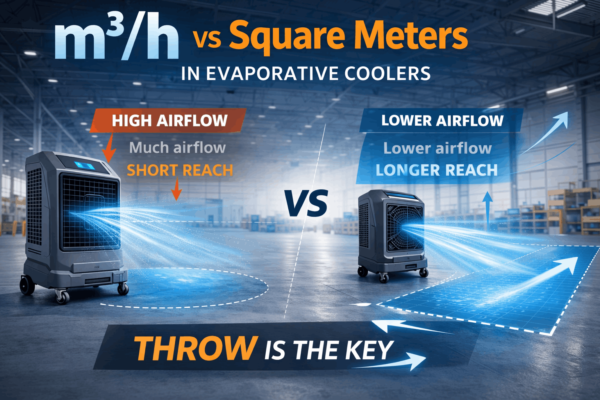
The m³/h value indicates how much air the machine moves at the outlet. However, this figure does not explain how that air is delivered. Two units with the same airflow can have completely different performance depending on their aerodynamic design.
The key concept: “Throw” or effective air reach
The most important technical concept is throw. This term defines the distance the air jet travels while maintaining a useful velocity that creates a cooling sensation.
Factors that determine good air reach:
-
Available pressure: a fan with higher pressure can better overcome air resistance.
-
Outlet design: an optimized outlet concentrates the airflow.
-
Air exit velocity: faster air breaks the ambient barrier and travels further.
Therefore, a unit with lower airflow but higher exit velocity may cool a deeper area than a high-airflow unit that disperses the air immediately after leaving the machine.
The hose analogy: absolute clarity
Imagine a garden hose. If you open the tap fully without a nozzle, a large volume of water flows (m³/h), but it falls at your feet. If you attach a narrow nozzle, less water flows, but the jet reaches the far end of the garden.
Exactly the same happens with evaporative cooling. Excess airflow without control creates a “bubble” of cold air around the machine that does not circulate through the space.
How to choose the right unit for your square meters
To avoid mistakes, do not rely only on the technical sheet. You must consider how the equipment will be used.
Localized cooling (spot cooling)
High airflow close to the unit can be useful.
Large areas or warehouses
You need reach and direction: an airflow capable of sweeping heat toward the natural exhaust points of the building.
It is also important to remember that each manufacturer calculates the covered square meters using different criteria (ceiling height, air changes per hour, etc.). For this reason, it is essential to trust brands that specify the real air reach of their equipment.
m³/h vs square meters in evaporative air coolers – Conclusion: air quality versus air quantity
In conclusion, more m³/h does not guarantee a larger cooled surface. The decisive factor is air delivery efficiency. When choosing your next evaporative cooler, prioritize ventilation technology and outlet design rather than the raw airflow figure.
Contact our specialists. We will help you find the most suitable models to solve the discomfort caused by heat.
Daniel Gerardo Fischman